Moreover, EV's typically cost much less to maintain. For example; there is no need for annual oil changes. There are fewer parts to maintain. And because of regenerative breaking - which breaks the car and generates power for the battery when the foot is removed from the accelerator, the brakes last significantly longer. The payback period will vary based on a variety of factors - including the range of the vehicle (how often it needs to be recharged) and the cost of charging (electricity costs vary widely across the country and different public EV charging stations add different surcharges, but the bottom line is that EVs are less expensive to operate than gas-powered vehicles.
It is well known that many people avoid EVs because of range anxiety. There are still not enough charging stations in the US, although they are being added rapidly. There were about 200,000 public chargers in the US at the end of 2024 - up from 114,000 at the end of 2021. For most EV drivers now- particularly those able to charge at home - range anxiety should not be a major issue.
As with any new technology, EV technology is evolving rapidly. Range in early EVs was under 100 miles per charge - and now it can exceed 500 miles. And we can expect it to continue to climb.
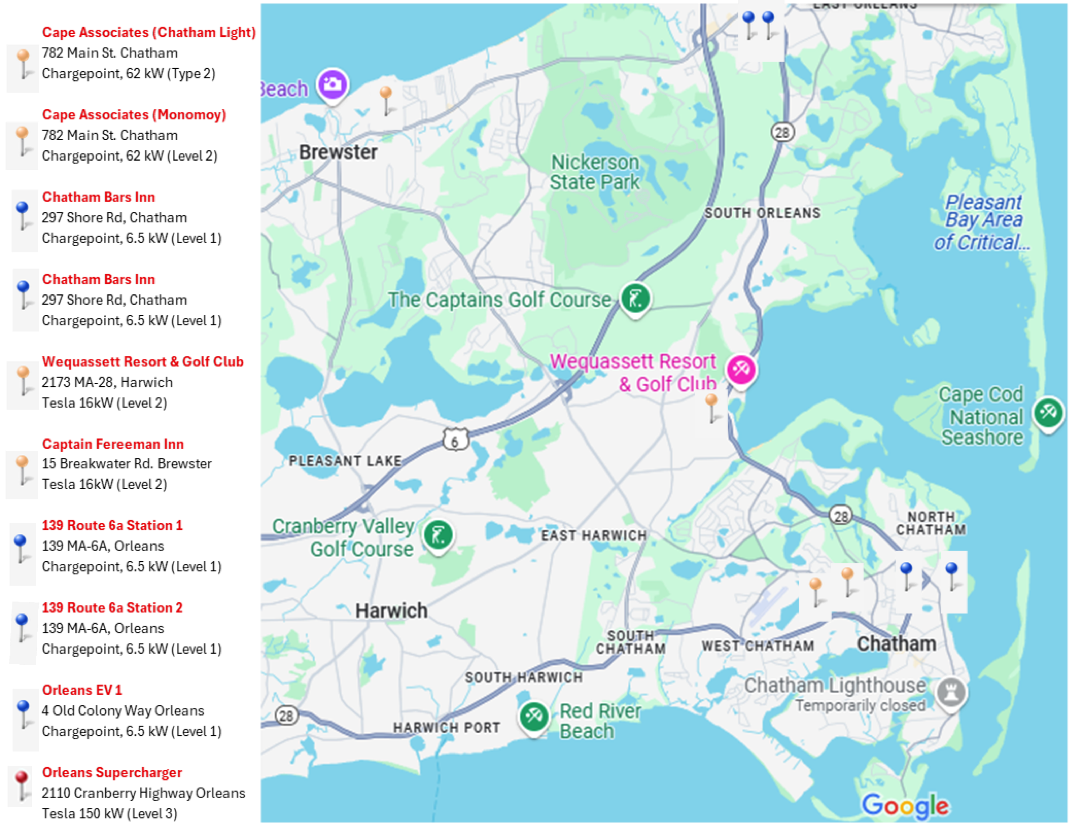
There are also chargers being installed at:
* The Eldridge Garage on Main Street
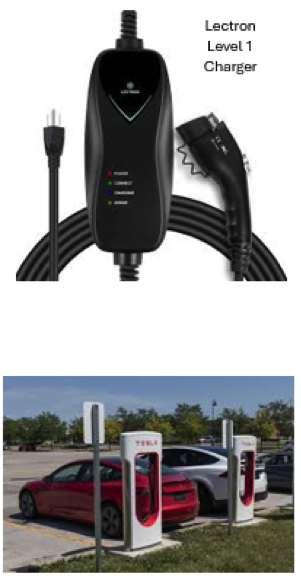
There are 3 different types of EV chargers:
* Level 1 chargers use a standard 120V power supply and are they least expensive. But they can only generate 3 - 6 miles of range per hour of charging - which is why they are the least common public charging stations. Overnight a Level 1 charger might provide 30 - 72 miles of charge, so a Level 1 home charger can be adequate for someone with a typical commute.
* Level 2 chargers are the most common public chargers - and the most common home chargers. They require a 240V line such as those typically used for an electric clothes dryer. They cost more to purchase - and more to install at home since the installer often needs to run a 240V line - but they charge much more quickly than Level 1 chargers - adding as much as 40 miles per hour of charging.
* Level 3 chargers - often referred to as a DC-Supercharger - clearly provide a significantly longer range - and have been becoming more and more powerful over the past few years. While Level 3 chargers typically deliver up to 200 miles of charge per hour, new ones are becoming available that can deliver that much range in in as little as 10 minutes.
While Level 2 Superchargers can cost under $1,000 to purchase, Level 3 chargers typically cost tens of thousands of dollars - in some cases in excess of $100,000. Hence fast chargers represent only about 25% of all public charge ports in the US - and virtually no home chargers. Tesla offers the largest number of public Superchargers in the country. Until recently they could only be used to charge Teslas but they recently enabled other manufactures to use their chargers, and one by one all other EV models are becoming able to charge with a Tesla Charger. This should also go a long way to address range anxiety.
There are Tesla Superchargers at the Sagamore Bridge and several other locations on Cape Cod - including the one in Orleans noted above. As with the case of range in general, speed of charging is being increased significantly.
Note that residents of the Cape can receive rebates of up to $700 from Cape Light Compact. Lower-income customers who qualify for Eversource's discount rate can receive up to $2,700 to upgrade their wiring and electric panel, in addition to qualifying for a free charger.
What most people are not aware of is that you do not actually need a charger to charge your EV. Most EVs come with adaptors that allow you to plug directly into a 120V or 240V circuit. The EV will charge more slowly without a charger. For this reason, charging with a 120V circuit will not provide sufficient range for many people. However, a 240V circuit without a charger should provide up to 30 miles per hour of charge, which will work for most people.
Bottom line: EVs make sense for almost everyone. And they are much more fun to drive.