Research and
Practice in Technology Enhanced Learning
© World
Scientific Publishing Company &
Asia-Pacific
Society for Computers in Education
SUSTAINING GROUP COGNITION IN A MATH CHAT ENVIRONMENT
GERRY STAHL
College
of Information Science & Technology,
Gerry.Stahl@drexel.edu
http://GerryStahl.net
Learning takes place over long periods of time that are
hard to study directly. Even the learning experience involved in solving a
challenging math problem in a collaborative online setting can be spread across
hundreds of brief postings during an hour or more. Such long-term interactions
are constructed out of posting-level interactions, such as the strategic
proposing of a next step. This paper identifies a pattern of exchange of postings
that it terms math proposal adjacency
pair, and describes its characteristics. Drawing on the methodology of
conversation analysis, the paper adapts this approach to investigating
mathematical problem-solving communication and to the computer-mediated
circumstances of online chat. Math proposals and other interaction methods constitute
the collaborative group as a working group, give direction to its problem
solving and help to sustain its shared meaning making or group cognition. Groups
sustain their online social and intellectual work by building up longer
sequences of math proposals, other adjacency pairs and a variety of interaction
methods. Experiences of collaboration and products of group cognition emerge
over time.
Keywords: group cognition; CSCL; mathematics education;
asynchronous chat; math proposal adjacency pair; failed proposal; conversation
analysis; intersubjective meaning making.
Research in learning has traditionally focused on psychological processes at the individual unit of analysis. With the shift to socio-cultural approaches in recent years, the community unit of analysis has come to the fore. In a new book on group cognition, we have identified small groups as defining a middle ground between individual people and communities of practice:
Small groups are the engines of knowledge building. The knowing that groups build up in manifold forms is what becomes internalized by their members as individual learning and externalized in their communities as certifiable knowledge. At least, that is a central premise of this book. (Stahl, 2006b, p. 16)
The concept of group cognition, however, retains a certain ambiguity of scale. On the micro level, it is based on the discovery by conversation analysis that a smallest element of meaning in discourse is the adjacency pair, a product of interaction within a dyad or small group, and not an expression of individual cognition (Duranti, 1998; Schegloff, 1991). On the macro level, it is a vision of collaborative knowledge building, where knowledge arises through community, interpersonal or social interaction (Lave & Wenger, 1991; Scardamalia & Bereiter, 1996; Vygotsky, 1930/1978). Taking one approach or the other, we can analyze how a small group of students establishes a detailed point of shared understanding or we can, for instance, analyze how they apprentice participation in the community of math discourse. The question remains: how can we understand what happens in a group at the interesting meso level during a one-hour math chat consisting of many detailed interactions but perhaps not measurably increasing the group’s community participation?
This paper tries to address the gap in the methodology of the learning sciences in a preliminary way. It begins with a detailed analysis of a particular interaction that actually occurred in a student chat. It then gradually broadens the discussion of online math chat sessions, discussing various aspects of how the elemental adjacency pairs in such a momentary interaction contribute to a sustained group experience over a somewhat longer period of time. The presentation proceeds through these steps:
1. The context of online math chats which provide the empirical basis for our observations is first motivated and described.
2. The concept of adjacency pairs from conversation analysis is adapted to the situation of online math chats and is particularized as “math proposal adjacency pairs.”
3. A specific adjacency pair is analyzed as a “failed proposal,” which by contrast sheds light on the nature of successful proposals.
4. We then describe our design-based research approach in which we revise our software and pedagogy in response to issues observed during a sequence of evolving trials.
5. Next, we look at a more extended interaction that occurred in our revised chat environment, involving methods of computer-supported deictic referencing that build from adjacency pairs to longer sequences of cognitive work.
6. To extrapolate beyond one or two detailed interactions and analyze more extended sessions with some generality would require volumes of exposition. We therefore rely on our other studies, our general impressions from observing and participating in many online math chats, and from related work by others to discuss a number of relevant aspects of sustained group cognition.
7. We conclude with reflections on how groups construct and sustain their on-going sense of shared experience. This points to future work.
1. Doing Mathematics Together Online
Technology-enhanced learning offers many opportunities for innovation in education. One of the major avenues is by supporting the building of collaborative meaning and knowledge (Stahl, 2006b). For instance, it is now possible for students around the world to work together on challenging math problems. Through online discussion, they can share problem-solving experiences and gain fluency in communicating mathematically. Research on mathematics education stresses the importance of student discourse about math (NCTM, 2000; Sfard, 2002), something that many students do not have opportunities to practice face-to-face.
While much research on computer-supported collaborative learning (CSCL) has analyzed the use of asynchronous threaded discussion forums, there has been relatively little research on the use of synchronous chat environments in education. The research reported here suggests that chat has great promise as a medium for collaborative learning if the medium and its use are carefully configured. This paper investigates how math discourse takes place within the chat medium and how we use our analyses to inform the design of effective math chat environments.
In the Virtual Math Teams (VMT) research project at the Math Forum (http://mathforum.org/vmt), we invite middle-school students to participate in online chats about interesting problems in beginning algebra and geometry. The following math problem, discussed in the chat excerpt analyzed below, is typical:
If two equilateral triangles have edge-lengths of 9 cubits and 12 cubits, what is the edge-length of the equilateral triangle whose area is equal to the sum of the areas of the other two?
We rely on a variety of approaches from the learning sciences to guide our research and to analyze the results of our trials, including coding along multiple dimensions (Strijbos & Stahl, 2005), analysis of threading (Cakir et al., 2005) and ethnography (Shumar, 2006). In particular, we have developed an ethnomethodologically-informed (Garfinkel, 1967; Heritage, 1984) chat analysis approach based on conversation analysis (Pomerantz & Fehr, 1991; Psathas, 1995; Sacks, 1992; Sacks, Schegloff, & Jefferson, 1974; ten Have, 1999) to understand the structure of interactions that take place in student chats. In this paper, we adapt a finding of conversation analysis to math chats and analyze a specific form of adjacency pairs that seem to be important for this context. Before presenting these findings, it may be useful to describe briefly how the notion of adjacency pairs differs from naïve conceptions of conversation.
There is a widespread common-sense or folk-theory (Bereiter, 2002; Dennett, 1991) view of conversation as the exchange or transmission of propositions (Shannon & Weaver, 1949). This view was refined and formalized by logicians and cognitive scientists as involving verbal “expression” in meaningful statements by individuals, based on their internal mental representations. Speech served to transfer meanings from the mind of a speaker to the mind of a listener, who then interpreted the expressed message. Following Wittgenstein (1953) in critiquing this view, speech act theory (Austin, 1952; Searle, 1969) argued that the utterances spoken by individuals were ways of acting in the world, and were meaningful in terms of what they accomplished through their use and effects. Of course, the expression, transmission and interpretation of meaning by individuals can be problematic, and people frequently have to do some interactional work in order to re-establish a shared understanding. The construction of common ground has been seen as the attempt to coordinate agreement between individual understandings (Clark & Brennan, 1991).
Conversation analysis takes a different view of conversation. It looks at how interactional mechanisms, like the use of adjacency pairs, co-construct inter-subjectivity.
Adjacency pairs are common sequences of utterances by different people—such as mutual greetings or question/answer interchanges—that form a meaningful speech act spanning multiple utterances, which cannot be attributed to an individual or to the expression of already formed mental states. They achieve meaning in their very interaction.
We are interested in what kinds of adjacency pairs are typical for math chats. The topic of adjacency pairs is taken up extensively in sections 2 and 6.1 below. Stahl (2006b) further discusses the implications that viewing adjacency pairs as the smallest elements of meaning making has for the intersubjective foundation of group cognition, a process of jointly constructing meaning in discourse.
The medium of online chat has its own peculiarities (Lonchamp, 2006; Mühlpfordt & Wessner, 2005; O'Neill & Martin, 2003). Most importantly, it is a text-based medium, where interaction takes place by the sequential response of brief texts to each other (Livingston, 1995; Zemel, 2005). As a quasi-synchronous medium (Garcia & Jacobs, 1999), chat causes confusion because several people can be typing at once and their texts can appear in an order that obscures to whom or to what they are responding. Furthermore, under time pressure to submit their texts so that they will appear near the post to which they are responding, some chat participants break their messages into several short texts. Because of these peculiarities of chat, it is necessary for researchers to carefully reconstruct the intended threading of texts that respond to each other before attempting to interpret the flow of interaction (Cakir et al., 2005; Strijbos & Stahl, 2005).
Math chats differ from ordinary informal conversation in a number of additional ways. They are focused on the task of solving a specific problem, and they take place within a somewhat formal institutional setting. They involve the doing of mathematics (Livingston, 1986). And, of course, they are computer-mediated rather than face-to-face. The approach of conversation analysis is based on ethnomethodology (Garfinkel, 1967), which involves the study of the methods that people use to accomplish what they are doing. So, we are interested in working out the methods that are used by students in online math chats. In this paper we discuss a particular method of collaboration in math chats that we have elsewhere called exploratory participation: participants engage each other in the conjoint discovery and production of both the problem and possible solutions (Wegerif, 2006; Zemel, Xhafa, & Stahl, 2005).
2. Math proposal adjacency pairs
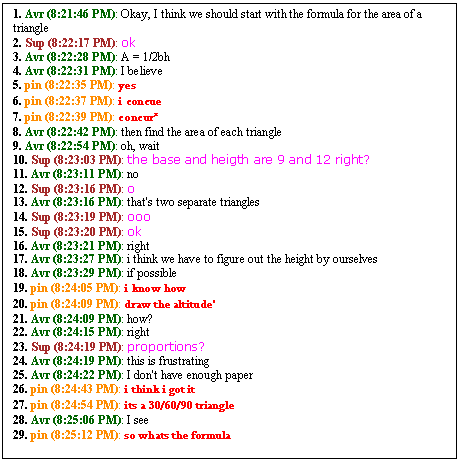
In order to begin to analyze the methods that students use in math chats, we take a close look at an excerpt from an actual chat. Figure 1 shows an excerpt from near the beginning of the log of one of our first online collaborative math problem-solving sessions. Three students—named Avr, Sup and Pin—have just entered the chat room, said hello to each other and read the problem involving three triangles.
The first thing to notice here is a pattern of proposals, discussions and acceptances similar to what takes place in face-to-face discourse. Bids for proposals about steps in solving the math problem are made by Avr in lines 1, 3, 8, 17 and by Pin in lines 20, 27. These proposals are each affirmed by someone else in lines 2, 6, 10, 19, 22, 28, respectively.
To avoid chat confusion, note that line 21 responds to line 19, while line 22 responds to line 20. The timestamps show that lines 20 and 21 effectively overlapped each other chronologically: Avr was typing line 21 before she saw line 20. Similarly, lines 24 and the following were responses to line 20, not line 23. We will correct for these confusions later, in Figure 2, which reproduces a key passage in this excerpt.
In Figure 1, we see several examples of a three-step pattern:
1. A proposal bid is made by an individual for the group to work on: “I think we should ….”
2. A proposal acceptance is made on behalf of the group: “Ok,” “right”
3. There is an elaboration of the proposal by members of the group. The proposed work is begun, often with a secondary proposal for the first sub-step.

 The three-step pattern consists of a pair of
postings—a bid and an acceptance—that form a proposal about math, and some
follow-up effort. This suggests that collaborative problem-solving of
mathematics may often involve a particular form of adjacency pair. We will call
this a math proposal adjacency pair.
The three-step pattern consists of a pair of
postings—a bid and an acceptance—that form a proposal about math, and some
follow-up effort. This suggests that collaborative problem-solving of
mathematics may often involve a particular form of adjacency pair. We will call
this a math proposal adjacency pair.
Here are seven successful math proposal adjacency pairs from Figure 1:
1. Avr:
Okay, I think we should start with the formula for the area of a triangle
2. Sup:
ok
3. Avr:
A = 1/2bh
6. pin:
i concue
8. Avr:
then find the area of each triangle
10. Sup:
the base
and heigth are 9 and 12 right?
17. Avr:
i think we have to figure out the height by ourselves
19. pin:
i know
how
20. pin: draw the altitude'
22. Avr: right
27. pin:
its a
30/60/90 triangle
28. Avr: I see
Note that the response is not always literally immediately adjacent to the bid in the chat log due to the complexities of chat posting. But the response is logically adjacent as an up-take of the bid.
Many varieties of adjacency pairs allow for the insertion of other pairs between the two parts of the original pair, delaying completion of the original pair. For instance, a question/answer pair may be delayed by utterances seeking clarification of the question. As we will see in Section 5, the clarification interaction may itself consist of question/answer pairs, possibly with their own clarifications—this may continue recursively. With math proposal adjacency pairs, the subsidiary pairs seem to come after the completion of the original pair, in the form of secondary proposals, questions or explanations that start to do the work that was proposed in the original pair. This characteristic leads to their role in sustaining group inquiry.
Math proposals tend to lead to some kind of further mathematical work as a response to carrying out what was proposed. Often—as seen in the current example—that work consists of making further proposals. In this way, the three-step structure of the math proposal adjacency pair starts to sustain the group interaction. The proposal bid by one person calls forth a proposal response by someone else. If the response is one of acceptance, it in turn calls forth some further work to be done or a bid for another proposal. If the response is a rejection, it may lead to justification, discussion and negotiation.
It is striking that the proposed work is not begun until there is agreement with the proposal bid. This may represent consent by the group as a whole to pursue the proposed line of work. Of course, this idea is not so clear in the current example, where there are only three participants and the interaction often seems to take place primarily between pairs of participants. As confirmed by other chat examples, however, the proposal generally seems to be addressed to the whole group and opens the floor for other participants to respond. The use of “we” in “we should” or “we have to” (stated or implied) constitutes the multiple participants as a plural subject—an effective unified group (Lerner, 1993). Any one other than the proposer may respond on behalf of the group. The fact that the multiple participants are posited as a group for certain purposes, like responding to a proposal bid, by no means rules out their individual participation in the group interaction from their personal perspectives, or even their independent follow-up work on the math. It simply means that the individual who responds to the bid may be doing so on behalf of the group.
Moreover, there seems to be what in conversation analysis is called an interactional preference (Schegloff, Jefferson, & Sacks, 1977) for acceptance of the proposal. That is, if one accepts a proposal, it suffices to briefly indicate agreement: “ok.” If one wants to reject a proposal, however, then one has to account for this response by giving reasons. If the group accepts the bid, one person’s response may serve on behalf of the group; if the group rejects the bid, several people may have to get involved.
We would like to characterize in more detail the method of making math proposal adjacency pairs. Often, the nature of an interactional method is seen most clearly when it is breached (Garfinkel, 1967). Methods are generally taken for granted by people; they are not made visible or conducted consciously. It is only when there is a breakdown (Heidegger, 1927/1996; Winograd & Flores, 1986) in the smooth, tacit performance of a method that people focus on its characteristics in order to overcome the breakdown. The normally transparent method becomes visible in its breach. In common-sense terms we say, “The exception proves the rule,” meaning that when we see why something is an exceptional case it makes clear the rule to which it is an exception. Heidegger made this into an ontological principle, whereby things first become experience-able during a breakdown of understanding. Garfinkel uses this, in turn, as a methodological fulcrum to make visible that which is commonly assumed and is effective but unseen.
We can interpret Sup’s posting in line 23 as a failed proposal. Given the mathematics of the triangle problem, a proposal bid related to proportionality, like Sup’s, might have been fruitful. However, in this chat, line 23 was effectively ignored by the group. While its character as a failed proposal did not become visible to the participants, it can become clear to us by comparing it to successful proposal bids in the same chat and by reflecting on its sequential position in the chat in order to ask why it was not a successful bid. This will show us by contrast what the characteristics are that make other proposal bids successful.
3. A Failed Proposal
Let us look at line 23 in its immediate interactional context in Figure 2. We can distinguish a number of ways in which it differed from successful math proposal bids that solicited responses and formed math proposal adjacency pairs:

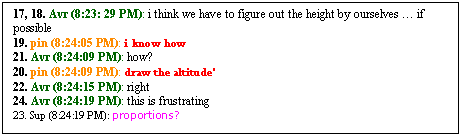 (a) All the other proposal bids (1, 3, 8, 17,
20, 27) were stated in relatively complete sentences. Additionally, some of them
were introduced with a phrase to indicate that they were the speaker’s proposal
bid (1. “I think we should …,” 17. “I think we have to …,” 20. “i know how …”
and 27. “i think i got it …”). The exceptions to these were simply
continuations of previous proposals: line 3 provided the formula proposed in
line 1 and line 8 proposed to “then” use that formula. Line 23, by contrast,
provided a single word with a question mark. There was no syntactic context (other
than the question mark) within the line for interpreting that word and there
was no reference to semantic context outside of the line. Line 23 did not
respond in any clear way to a previous line and did not provide any alternative
reference to a context in the original problem statement or elsewhere. For
instance, Sup could have said, “I think we should compute the proportion of the
height to the base of those equilateral triangles.”
(a) All the other proposal bids (1, 3, 8, 17,
20, 27) were stated in relatively complete sentences. Additionally, some of them
were introduced with a phrase to indicate that they were the speaker’s proposal
bid (1. “I think we should …,” 17. “I think we have to …,” 20. “i know how …”
and 27. “i think i got it …”). The exceptions to these were simply
continuations of previous proposals: line 3 provided the formula proposed in
line 1 and line 8 proposed to “then” use that formula. Line 23, by contrast,
provided a single word with a question mark. There was no syntactic context (other
than the question mark) within the line for interpreting that word and there
was no reference to semantic context outside of the line. Line 23 did not
respond in any clear way to a previous line and did not provide any alternative
reference to a context in the original problem statement or elsewhere. For
instance, Sup could have said, “I think we should compute the proportion of the
height to the base of those equilateral triangles.”
(b) The timing of line 23 was particularly unfortunate. It exactly overlapped a line from Avr. Because Avr had been setting the pace for group problem solving during this part of the chat, the fact that she was involved in following a different line of inquiry spelled doom for any alternative proposal around the time of line 23. Pin either seemed to be continuing on his own thread without acknowledging anyone else at this point, or else he was responding too late to previous postings. So a part of the problem for Sup was that there was little sense of a coherent group process—and what sense there was did not include him. If he was acting as part of the group process, for instance posing a question in reaction to Pin and in parallel to Avr, he was not doing a good job of it and so his contribution was ignored in the group process. It is true that a possible advantage of text-based interaction like chat over face-to-face interaction is that there may be a broader time window for responding to previous contributions. In face-to-face conversation, turn-taking rules may define appropriate turns for response that expire in a fraction of a second as the conversation moves on. In computer-based chat, the turn-taking sequence is more open. However, even here if one is responding to a posting that is several lines away, it is important to make explicit somehow the post to which one is responding. Sup could have said, “I know another way to find the height – using proportions.” His posting does not do anything like that; it relies purely upon sequential timing to establish its context, and that fails in this case.
(c) Sup’s posting 23 came right after Pin’s proposal bid 20: “draw the altitude.” Avr had responded to this with 22 (“right”), but Sup seems to have ignored that. Pin’s proposal had opened up work to be done and both Avr and Pin responded after line 23 with contributions to this work. So Sup’s proposal bid came in the middle of an ongoing line of work without relating to it. In sequential terms, he made a bid for a proposal when it was not time to make a proposal. Sup’s proposal bid was not positioned within the group effort to sustain a promising line of inquiry. It is like trying to take a conversational turn when there is not a pause that creates a turn-taking opportunity. Now, it is possible—especially in chat—to introduce a new proposal at any time. However, to do so effectively, one must make a special effort to bring the on-going work to a temporary halt and to present one’s new proposal as an alternative. Simply saying “proportions?” will not do it. Sup could have said, “Instead of drawing the altitude, let’s use proportions to find it.”
(d) To get a proposal response to a proposal bid, one can elicit at least an affirmation or recognition. Again, this is a matter of pre-structuring a sustained interaction. Line 23 does not really solicit a response. For instance, Avr’s question, 21: “how?” called for an answer—that was given by Pin in line 20, which actually appeared in the chat window just prior to the question and with the same time stamp. But Sup’s posting does not call for a specific kind of answer. Even Sup’s own previous proposal bid in line 10 ended with “right?”—requiring agreement or disagreement. Line 10 elicited a clear response from Avr, line 11 (“no”) followed by an exchange explaining why Sup’s proposal was not right.
(e) Other proposal bids in the excerpt are successful in contributing to sustaining the collaborative knowledge building or group problem solving in that they open up a realm of work to be done. One can look at Avr’s successive proposal bids on lines 1, 3, 8 and 17 as laying out a work strategy. This elicits a proposal response from Sup trying to find values to substitute into the formula and from Pin trying to draw a graphical construction that will provide the values for the formula. Sup’s proposal bid in line 23, however, neither calls for a response nor opens up a line of work. There is no request for a reaction from the rest of the group, and the proposal bid is simply ignored. Since no one responded to Sup, he could have continued by doing some work on the proposal himself. He could have come back and made the proposal more explicit, reformulated it more strongly, taken a first step in working on it, or posed a specific question related to it. But he did not—at least not until much later—and the matter was lost.
(f) Another serious hurdle for Sup was his status in the group at this time. In lines 10 through 16, Sup had made a contribution that was taken as an indication that he did not have a strong grasp of the math problem. He offered the lengths of the two given triangles as the base and height of a single triangle (line 10). Avr immediately and flatly stated that he was wrong (line 11) and then proceeded to explain why he was wrong (line 13). When he agreed (line 15), Avr summarily dismissed him (line 16) and went on to make a new proposal that implied his approach was all wrong (lines 17 and 18). Then Pin, who had stayed out of the interchange, re-entered, claiming to know how to implement Avr’s alternative proposal (lines19 and 20) and Avr confirmed that (line 22). Sup’s legitimacy as a source of useful proposals had been totally destroyed at precisely the point just before he made his ineffective proposal bid. Less than two minutes later, Sup tries again to make a contribution, but realizes himself that what he says is wrong. His faulty contributions confirm repeatedly that he is a drag on the group effort. He makes several more unhelpful comments later and then drops out of the discourse for most of the remaining chat. Sustaining a math chat discourse involves work to maintain an ongoing social interaction as well as work to continue the math inquiry. Proposal bids and other postings are constrained along multiple dimensions of efforts to sustain the activity.
The weaknesses of line 23 as a proposal bid suggest (by contrast, exception, breach or breakdown) some characteristics for successful proposals:
(a) a clear semantic and syntactic structure,
(b) careful timing within the sequence of postings,
(c) a firm interruption of any other flow of discussion,
(d) the elicitation of a response,
(e) the specification of work to be done and
(f) a history of helpful contributions.
In addition, there are other interaction characteristics and mathematical requirements. For instance, the level of mathematical background knowledge assumed in a proposal must be compatible with the expertise of the participants, and the computational methods must correspond with their training. Additional characteristics become visible in other examples of chats. Successful proposals contribute in multiple ways to sustaining the group cognitive process.
As we have just seen, the formulation of effective bids for math proposals involves carefully situating one’s posting within the larger flow of the chat. This is highly analogous to taking a turn in face-to-face conversation (Sacks et al., 1974). Where conversation analysis developed a systematics of turn taking, we are trying to discover the systematics of chat interaction. This would describe how math proposals and other chat methods must be designed to fit into—and thereby contribute to—the sustained flow of group interaction.
So far in this paper, the notion of math proposal adjacency pairs has been illustrated in just a single chat log excerpt. But in our research we have seen both successful and failed math proposals many times. Other researchers have also noted the role of successful and failed proposals in collaborative problem solving (Barron, 2003; Cobb, 1995; Dillenbourg & Traum, 2006; Sfard & McClain, 2003).
Each proposal bid and uptake is unique—in its wording and its context. The interactional work that it does and the structuring that it employs are situated in the local details of its sequential timing and its subtle referencing of unique and irreproducible elements of the on-going chat. Each group of students develops somewhat different methods of engaging with math problems and making math proposals. Even within a given chat, each posting pair that might be a proposal must be analyzed as a unique, meaning-making interaction in order to determine if it is in fact a math proposal adjacency pair. That is why case studies provide the necessary evidence—the essential details of interaction methods are lost in aggregation, in the attempt to overcome what Garfinkel (1967) terms the “irreducible indexicality” of the event. To the extent that identifying proposal pairs is a useful analytic approach, it is important to determine what interactional methods of producing such proposals are effective (or not) in fostering successful knowledge building and group cognition, as we have begun to do here.
An understanding of methods like proposal making can guide the design of activity structures for collaborative math. As we are collecting and analyzing a corpus of chat logs under different technological conditions, we are evolving the design of computer support through iterative trials and analyses.
4. Designing Computer Support
If the failure of Sup’s proposal about proportions is considered deleterious to the collaborative knowledge building around the triangles problem, then what are the implications of this for the design of educational computer-based environments? One response would be to help students like Sup formulate stronger proposals. Presumably, giving him positive experiences of interacting with students like Avr and Pin, who are more skilled in chat proposal making, would provide Sup with models and examples from which he can learn—assuming that he perseveres and does not drop out of the chat.
Another approach to the problem would be to build functionality into the software and structures into the activity that scaffold the ability of weak proposal bids to survive. As students like Sup experience success with their proposals, they may become more aware of what it takes to make a strong proposal bid.
Professional mathematicians rely heavily upon inscription—the use of specialized notation, the inclusion of explicit statements of all deductive steps and the format of the formal proof to support the discussion of math proposals—whether posted on an informal whiteboard, scrawled across a university blackboard or published in an academic journal. Everything that is to be referenced in the discussion is labeled unambiguously. To avoid ellipsis, theorems are stated explicitly, with all conditions and dependencies named. The projection of what is to be proven is encapsulated in the form of the proof, which starts with the givens and concludes with what is proven. Perhaps most importantly, proposals for how to proceed are listed in the proof itself as theorems, lemmas, etc. and are organized sequentially. (This view of proof is an idealization that abstracts from unstated tacit background knowledge of the mathematical community, as Livingston (1999) and Wittgenstein (1944/1956) before him have demonstrated.)
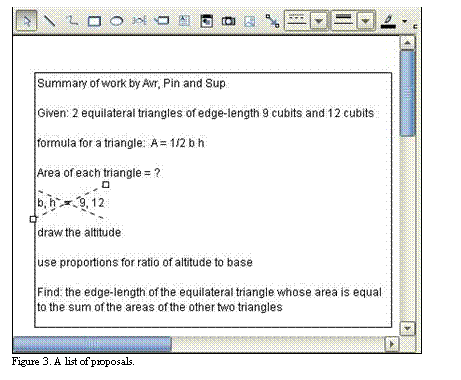
One could imagine a chat system supplemented with a window containing an informal list of proposals analogous to the steps of a proof. After Sup’s proposal, the list might look like Figure 3. When Sup made a proposal in the chat, he would enter a statement of it in the proof window in logical sequence. He could cross out his own proposal when he felt it had been convincingly argued against by the group (see dashed lines in Figure 3 crossing out the proposal that base and height = 9 and 12).
The idea is that important proposals that were made would be retained in a visible way and be shared by the group. Of course, there are many design questions and options for doing something like this. Above all, would students understand this functionality and would they use it? The design sketch indicated in Figure 3 is only meant to be suggestive.
Another useful tool for group mathematics would be a shared drawing area. In the chat environment used by Sup, Pin and Avr, there was no shared drawing, but a student could create a drawing and send it to the others. Pin did this twelve minutes after the part of the interaction shown in the excerpt. Before the drawing was shared, much time was lost due to confusion about references to triangles and vertices. For math problems involving geometric figures, it is clearly important to be able to share drawings easily and quickly. Again, there are many design issues, such as how to keep track of who drew what, who is allowed to erase, how to point to items in the drawing and how to capture a record of the graphical interactions in coordination with the text chatting.
 Because we are designing a
computer-supported experience that has never before existed and because we want
our design to be based on detailed study of how students actually create their
collaborative experience in the environment we are designing, we follow a
highly iterative try-analyze-redesign cycle of design-based research (Design-Based Research Collective, 2003), in order to asymptotically approach an
effective computer-supported environment and math discourse community.
Because we are designing a
computer-supported experience that has never before existed and because we want
our design to be based on detailed study of how students actually create their
collaborative experience in the environment we are designing, we follow a
highly iterative try-analyze-redesign cycle of design-based research (Design-Based Research Collective, 2003), in order to asymptotically approach an
effective computer-supported environment and math discourse community.
We started with a
simple online service. We used AOL’s IM commercial chat system that was already
familiar to many students. We invited students into chat rooms and presented a
problem from the Math Forum’s well-established Problem of the Month service. An
adult facilitator was present in the room to help with any technical problems.
When we saw how necessary a shared whiteboard was we tried an open source
solution and also WebCT’s and Blackboard’s interactive classrooms. Eventually
we collaborated with researchers in
Since the early AOL-based chat analyzed above, we have gone through many cycles of design, trial and analysis. In addition to designing support for persistent summaries of work (such as that in Figure 3) and a shared whiteboard for constructing geometric drawings (discussed in the following section and shown in Figure 4), we have incorporated the following: a referencing tool; a way for users to explicitly thread their chat postings; several forms of social awareness; tutorials on how to use the new features; a help system on using the tools, collaborating and problem-solving; and a lobby to support group formation. We have also experimented extensively with how best to formulate math problems or topics and how to provide feedback to students on their work.
5. References and Threading
The more we study chat logs, the more we see how interwoven the postings
are with each other and with the holistic Gestalt of the interactional context
that they form. There are many ways in which a posting can reference elements
of its context. The importance of indexicality to creating shared meaning was
stressed by Garfinkel (1967). Vygotsky also noted the central role of
pointing for mediating intersubjectivity in his analysis of the genesis of the
infant-and-mother’s pointing gesture (1930/1978, p. 56). Our analysis of face-to-face collaboration
emphasized that spoken utterances in collaborative settings tend to be
elliptical, indexical and projective ways of referencing previous utterances,
the conversational context and anticipated responses (Stahl, 2006b, chapter 12).
 Based
on these practical and theoretical considerations—and working with the
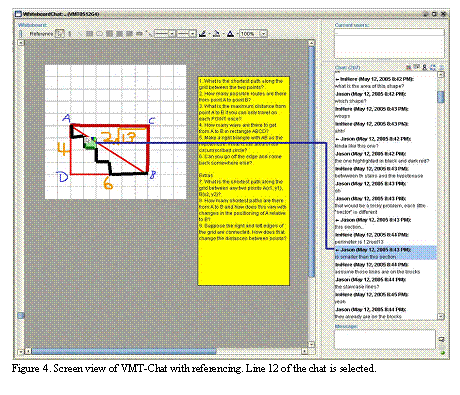
ConcertChat developers—we evolved the VMT-Chat environment. As shown in Figure 4,
it not only includes a shared whiteboard, but has functionality for referencing
areas of the whiteboard from chat postings and for referencing previous
postings. The shared whiteboard is necessary for supporting most geometry
problems. (This will save Avr the frustration of running out of paper, and also
let Pin and Sup see what she is drawing and add to it or reference it.) Sharing
drawings is not enough; students must be able to reference specific objects or
areas in the drawing. (For example, Sup could have pointed to elements of the
triangles that he felt to be significantly proportional.) The whiteboard also
provides opportunities to post text where it will not scroll away. (Sup could
have put his failed proposal in a text box in the whiteboard, where he or the
others could come back to it later.) The graphical references (see the bold
line from a selected posting to an area of the drawing in Figure 4) can also be
used to reference one or more previous postings from a new posting in order to
make the threads of responses clearer in the midst of “chat confusion” (Fuks, Pimentel, & de Lucena, 2006).
Based
on these practical and theoretical considerations—and working with the
ConcertChat developers—we evolved the VMT-Chat environment. As shown in Figure 4,
it not only includes a shared whiteboard, but has functionality for referencing
areas of the whiteboard from chat postings and for referencing previous
postings. The shared whiteboard is necessary for supporting most geometry
problems. (This will save Avr the frustration of running out of paper, and also
let Pin and Sup see what she is drawing and add to it or reference it.) Sharing
drawings is not enough; students must be able to reference specific objects or
areas in the drawing. (For example, Sup could have pointed to elements of the
triangles that he felt to be significantly proportional.) The whiteboard also
provides opportunities to post text where it will not scroll away. (Sup could
have put his failed proposal in a text box in the whiteboard, where he or the
others could come back to it later.) The graphical references (see the bold
line from a selected posting to an area of the drawing in Figure 4) can also be
used to reference one or more previous postings from a new posting in order to
make the threads of responses clearer in the midst of “chat confusion” (Fuks, Pimentel, & de Lucena, 2006).
In one of our first
chats using VMT-Chat, the students engaged in a particularly complex
interaction of referencing a figure in the whiteboard whose mathematics they
wanted to explore (Stahl, Zemel et al., 2006). Here is the chat log from Figure 4 (graphical
references to the whiteboard are indicated by “[REF TO WB]” in the log):
1 ImH: what is the area of this
shape? [REF TO WB]
2 Jas: which shape?
3 ImH: woops
4 ImH: ahh!
5 Jas: kinda like this one? [REF
TO WB]
6 Jas: the one highlighted in
black and dark red?
7 ImH: between
th stairs and the hypotenuse
8 Jas: oh
9 Jas: that would be a tricky problem, each little
“sector” is different
10 Jas: this section [REF TO
WB]
11 ImH: perimeter is 12root3
12 Jas: is smaller than this section
[REF TO WB]
13 ImH: assume those lines are
on the blocks
14 Jas: the staircase lines?
15 ImH: yeah
16 Jas: they already are on
the blocks
Line 1 of the chat
textually references an abstract characteristic of a complex graphical form in
the whiteboard: “the area of this shape.” The software function to support this
reference failed, presumably because the student, ImH, was not experienced in
using it and did not cause the graphical reference line to point to anything in
the drawing. Line 5 provides a demo of how to use the referencing tool. Using
the tool’s line, a definite textual reference (“the one”) and the use of line
color and thickness in the drawing, lines 5 and 6 propose an area to act as the
topic of the chat. Line 7 makes explicit in text the definition of a sub-area
of the proposed area. Line 8 accepts the new definition and line 9 starts to
work on the problem concerning this area. Line 9 references the problem as
“that” and notes that it is tricky because the area defined does not consist of
standard forms whose area would be easy to compute and add up. It refers to the
non-uniform sub-areas as little “sectors.” Line 10 then uses the referencing
tool to highlight (roughly) one of these little sectors or “sections.” Line 12
continues line 10, but is interrupted in the chat log by line 11, a failed
proposal bid by ImH. The chat excerpt continues to reference particular line
segments using deictic pronouns and articles as well as a growing vocabulary of
mathematical objects of concern: sectors, sections, lines, blocks.
Progress is made
slowly in the collaborative exploration of mathematical relationships, but
having a shared drawing helps considerably. The students use multiple textual
and graphical means to reach a shared understanding of mathematical objects
that they find interesting but hard to define. In this excerpt, we start to get
a sense of the complex ways in which brief textual postings weave dense webs of
relationships among each other and with other elements of the collaborative
context.
This example shows
how creating shared meaning can require more than a simple adjacency pair. In
order to establish a reference to “this shape” that could allow the two
participants to discuss that math object, the dyad had to construct a complex
involving nested question/answer pairs, math proposal pairs, a failed proposal
bid, drawing, coloring, labeling, pointing, multiple repairs, computations.
Here we see a more sustained group cognitive process. Across 16 postings and
considerable coordinated whiteboard activity during two minutes, the student
dyad defines a math object for investigation. The definition is articulated by
this whole sequence of combined and intricately coordinated textual and
graphical work.
6. Sustaining the Group Interaction
The goal of our research is to provide a service to students that will allow them to have a rewarding experience collaborating with their peers in online discussions of mathematics. We can never know exactly what kind of subjective experience they had, let alone predict how they will experience life under conditions that we design for them. For instance, it is methodologically illegitimate to ask if ImH already “intended” or “had in mind” in line 1 the shape that the group subsequently arrived at. We know from the log that ImH articulated much of the explicit description, but he only did this in response to Jas. If we interviewed ImH afterwards he might quite innocently and naturally project this explicit understanding back on his earlier state of mind as a retrospective account or rationalization (Suchman, 1987).
Our primary access
to information related to the group experiences comes from chat logs (including
the whiteboard history). The logs capture most of what student members see of
their group on their computer screens. They therefore constitute a fairly
complete record of everything that the participants themselves had available to
understand their group interaction. We can even replay the logs so that we see
how the session unfolded sequentially in time. Of course, we are not engaged in
the interaction the way the participants were, and recorded experiences never
quite live up to the live version because the engagement is missing. To gain
some first-hand experience, we do test out the environments ourselves and enjoy
the experience, but we experience math and collaboration differently than do
middle-school students. We also interview students and their teachers, but
teenagers rarely reveal much of their life to adults.
So we try to
understand how collaborative experiences are structured as interpersonal
interactions that are sustained over time. The focus is not on the individuals
as subjective minds, but on the human, social group as constituted by the
interactions that take place within the group. Although we generally try to
ground our understanding of interaction through close, detailed analysis of
excerpts from chat recordings, we do not have room to document our analysis of
longer scale structures at that level of detail in this paper. We have
collected over 50 hours of small-group chat about math. We engage in weekly
collaborative data sessions (Jordan & Henderson, 1995) to develop case studies of unique chat
excerpts. A number of published papers arising from these sessions are
available at http://www.mathforum.org/vmt/researchers/publications.html.
The discussion in the remainder of this paper is a high-level summary based on
what we have observed.
6.1. Replies, up-take, pairs and triplets
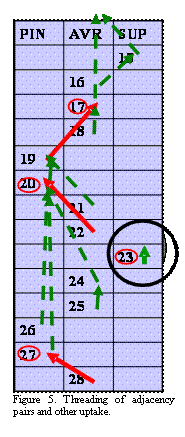
Figure 5 provides a diagram of the responses
of postings in the chat discussed in Sections 2 and 3 above involving Avr, Pin
and Sup. The numbers of the posts by each participant are placed in
chronological order in a column for that participant. Math proposal adjacency
pairs are connected with solid arrows and other kinds of responses are
indicated with dashed arrows. Note that Sup’s failed proposal bid (line 23) is
isolated. Most of the chat, however, has coherence, flow or motion due to the
fact that most postings are responses to previous messages. This high level of
responses is due to the fact that many postings elicit responses or up-take,
the way that a greeting invariably calls forth another greeting in response, or
a question typically produces an answer. In a healthy conversation, most
contributions by one participant are taken up by others. Conversationalists
work hard to fit their offerings into the timing and evolving focus of the
on-going interaction. In chat, the timing, rules and practices are different,
but the importance of up-take remains.
The fact that the
group process and the cross-ties between people are central to collaborative
experiences does not contradict the continuing importance of the individuals.
The representation of Figure 5 uses columns to indicate the connections and
implicit continuity within the sequence of contributions made by an individual (compare the representation in Sfard &
McClain, 2003). We may project psychological
characteristics onto the unity of an individual’s postings, attributing this
unity to personal interests, personality, style, role, etc. Such attributions
may change as the chat unfolds. The point is that the individual coherence and
unfolding of each participant’s contributions adds an important dimension of
implicit sustaining connections among the postings.
 Adjacency
pairs like math proposals, greetings and questionings provide important ties
that cut across the connections of individual continuities. They form the
smallest elements of shared meaning precisely by binding together postings from
different people. A proposal bid that is not taken up is not a meaningful
proposal, but at best a failed attempt at a proposal. A one-sided greeting that
is not recognized by the other is not an effective greeting. An interrogative
expression that does not call for a response is no real questioning of another.
These adjacency pairs are all interactional moves whose meaning consists in a
give-and-take between two or more people. When we hear something that we
recognize as a proposal bid, a greeting or a question, we feel required to
attempt an appropriate response. We may ignore the proposal bid, snub the
greeter or refuse to answer the question, but then our silence is taken as a
response of ignoring, snubbing or refusing—and not simply a lack of response.
Adjacency
pairs like math proposals, greetings and questionings provide important ties
that cut across the connections of individual continuities. They form the
smallest elements of shared meaning precisely by binding together postings from
different people. A proposal bid that is not taken up is not a meaningful
proposal, but at best a failed attempt at a proposal. A one-sided greeting that
is not recognized by the other is not an effective greeting. An interrogative
expression that does not call for a response is no real questioning of another.
These adjacency pairs are all interactional moves whose meaning consists in a
give-and-take between two or more people. When we hear something that we
recognize as a proposal bid, a greeting or a question, we feel required to
attempt an appropriate response. We may ignore the proposal bid, snub the
greeter or refuse to answer the question, but then our silence is taken as a
response of ignoring, snubbing or refusing—and not simply a lack of response.
In fact, the way
that a response is taken is also part of the interaction itself. In discussing
the building of “common ground,” Clark argues that shared understanding by A
and B of A’s utterance involves not only B believing that he understands A, but
also A agreeing that B understands (Clark & Brennan, 1991). This requires an interaction spanning
multiple utterances. For instance, the most prevalent interaction in classroom
discourse is when a teacher poses a question, a student provides an answer
demonstrating understanding and then the teacher acknowledges the student
response as such an understanding (Lemke, 1990). Here, the elemental cell of interactional
meaning making is a sequence of contributions by different people.
It is clear in this
analysis that the meaning is constructed through the interaction of multiple
people, and is not a simple expression of pre-existing mental representations
in any one individual’s head. This is the philosophical importance of the
concept of adjacency pair: that meaning in groups is made through the
interaction of multiple people, not completely by an individual’s mental
activity. In calling this “group cognition,” we extend the term “cognition”
from individual psychology to apply to processes in which small groups through
their discourse construct meaning structures like logical arguments or
mathematical proofs—that is, they engage in processes which are considered thinking
when conducted by individual people. This approach is consistent with
dialogical theories that actually view higher-level thinking by individuals as
derivative of such intersubjective meaning making (Bakhtin, 1986; Linell, 2001; Stahl,
Koschmann, & Suthers, 2006; Vygotsky, 1930/1978; Wegerif, 2006).
6.2. Longer sequences
Although much attention has been given to adjacency pairs in conversation analysis and although such pairs can be thought of as the elements of meaning making in collaborative interaction, they form only one of many levels of analysis. For instance, there are longer sequences (Sacks, 1992, vol. II, p. 354), episodes (Linell, 2001) and topics in dialogs and chats (Zemel, Xhafa, & Cakir, 2005) that provide layers of structure and sense. An hour-long chat is not a homogeneous interchange. A typical math chat might start with a period of introductions, greetings, socializing. Then there could be some problem-solving work. This might be periodically interrupted by joking, playing around, or silliness. People may come and go, requiring catching up and group reorganization. Each of these episodes has boundaries during which the group members must negotiate whether or not to stop what they were doing and start something else. These transitions may themselves be longer sequences of interaction, especially in large groups. We have barely begun to explore these different layers.
In social
conversation, people work hard to strike up conversations, to propose new
topics of mutual interest and to keep the conversation going. Online math chats
face similar challenges. Students hesitantly greet each other and get things
started. Math proposals are often used to introduce new topics and to carry
forward a train of thought together. Finally, participants engage in
considerable interaction work to sustain their sessions, intertwining humor,
socializing and math inquiry—often using one of these modes to sustain others.
Eventually every group decides to disband, at least until a future session.
The referencing
excerpt from VMT-Chat in Section 5 above was from the second hour-long session
in a series of four chats by the same group. The sessions referred back to
previous sessions and prepared for future ones. We hope to foster a community
of Math Forum users who come back repeatedly to math chats, potentially with
their friends. Their chats will reference other chats and different online
experiences, building connections at the community level. This adds more layers
of interconnections. It may sustain group interaction, inquiry and reflection
over more significant periods of time.
6.3. Constructing proofs
Learning math involves becoming skillful in the social practices of the math community (Livingston, 1999). The math community is an aspect of the world-historical global community. The most central participants are the great mathematicians, who have invented new mathematical objects and developed new forms of mathematical practice (Sfard & Linchevski, 1994). Most of the population has low math literacy and participates on the periphery of the math discourse community. They are unable to manipulate math concepts fluidly in words or mathematical symbolism (Sfard, 2002). Nevertheless, they can use basic arithmetic methods for practical purposes (Lave, 1988). One of the most fundamental methods of math is counting, which children are drilled at extensively. Formal math assumes that the practitioner is skilled at following rules, such as the non-formalized rules of numeric sequencing (Wittgenstein, 1944/1956).
In our chats,
students work on math problems and themes. In solving problems and exploring
math worlds or phenomena, the groups construct sequences of mathematical
reasoning that are related to proving. Proofs in mathematics have an
interesting and subtle structure. To understand this structure, one must
distinguish:
·
the
problem statement-and-situation;
·
the
exploratory search for a solution;
·
the
effort to reduce a haphazard solution path to an elegant, formalized proof;
·
the
statement of the proof; and
·
the
lived experience of following the proof (Livingston, 1986, 1987).
Each of these has its own structures and practices. Each implicitly
references the others. To engage in mathematics is to become ensnarled in the
intricate connections among them. To the extent that these aspects of doing
math have been distinguished and theorized, it has been done as though there is
simply an individual mathematician at work. There has been virtually no
research into how these could be accomplished and experienced
collaboratively—despite the fact that talking about math has for some time been
seen as a priority in math education (NCTM, 1989; Sfard, 2002).
6.4. The stream of group consciousness
Psychologists like William James and novelists like Jack Kerouac have described narratives that we tell ourselves silently about what we are doing or observing as our stream of consciousness. This “inner voice” rattles on even as we sleep, making connections that Sigmund Freud found significant (if somewhat shocking in his day). In what sense might online chats—with their meanderings, flaming, associative referencing, unpredictable meaning making and unexpected images—deserve equal status as streams of (group) consciousness? Group cognition can be self-conscious: The group discourse can talk about the existence of the group discourse itself and comment on its own characteristics.
Our sense of sustained
time and the rhythms of life are largely reliant upon the narratives we tell
ourselves (Bruner, 1990; Sarmiento, Trausan-Matu,
& Stahl, 2005). We know that we have already lived through
a certain part of the day or of our life because our present is located within
a nexus of ties to the past or hopes for the future. In similar ways, a chat’s
web of references that connects current postings to prior ones to which they
respond and to future postings that they elicit defines a temporality of the
chat. This is experienced as a lived sense of time that is shared by the group
in the chat. Like our individual internal clocks, the group temporality is
attuned to the larger world outside—the world of family life that calls the
students away from the chat for dinner or the world of school that interrupts a
chat with class changes or homework pressures. The temporality that defines a
dimension of the collaborative experience is constrained by the nature of the
social situation and by the functionality of the technological environment.
7. Constructing the Group Experience
Groups constitute themselves (Garfinkel, 2006, pp. 189ff; Sacks, 1992, vol.
I, pp. 144-149). We can see how they do this in the chat
logs. At one level the VMT service brings several students together and locates
them in a chat room together. It may supply a math problem for them to work on
and it may provide a facilitator who introduces them to the environment. At
this point, they are a potential group with a provisionally defined membership.
The facilitator might say something like, “Welcome to our first session
of Virtual Math Teams! I am the facilitator for your session. . . . As a group,
decide which question you would like to work on.” (This is, in fact, part of the facilitator script from the session
involving ImH and Jas excerpted above.) Here we can see that the facilitator
has defined the group (“as a group … you”) and distinguished her own role as
outside the group (“I am the
facilitator … your session”). The
potential group projected by the facilitator need not necessarily materialize.
Individual students may come to the setting, look around, decide it is lame,
and leave as individuals. However, this rarely happens. Sometimes an individual
will leave without ever interacting, but as long as enough students come there,
a group emerges.
Students enter the
chat environment with certain motivations, expectations and experiences. These
are generally sufficient to get the group started. One can see the group form
itself. This is often reflected in the shift from singular to plural pronouns:
“Let’s get started. Let us do some math.” We saw this in Avr’s
proposal: “I
think we have to figure out the
height by ourselves.” The proposal
bid comes from an individual, but the projected work is for the group. Through
her use of “we,” Avr constitutes the group. Through her proposal bid, she
constitutes the group as a recipient of the bid and elicits a response from
them. Someone other than Avr must respond to the bid on behalf of the group.
When Pin says, “I know how: draw the altitude,” he is accepting Avr’s proposal
as a task for the group to work on and in so doing he makes a proposal about
how the group should go about approaching this task (by making a geometric
construction). In this interchange, the group (a) is projected as an agent (“we”)
in the math work (Lerner, 1993), and (b) is actually the agent of meaning
making because the meaning of Avr’s proposal is defined by the interaction
within the group (e.g., by a math proposal adjacency pair).
If the group
experience is a positive one for the participants, they may want to return.
Some chats end with people making plans to get together again. In some
experiments, the same groups attended multiple sessions. We would like to see a
community of users form, with teams re-forming repeatedly and with old-timers
helping new groups to form and learn how to collaborate effectively.
The recognition
that collaborative groups constitute themselves interactionally and that their
sense making takes place at the group unit of analysis has implications for the
design of cognitive tools for collaborative communities. The field of
computer-supported collaborative learning (CSCL) was founded a decade ago to
pursue the analysis of group meaning making and the design of media to support
it (Stahl, Koschmann et al., 2006). We view the research described here as a
contribution to this CSCL tradition.
We are designers of
tools for collaborative groups. We want to design an online collaborative
service, with strong pedagogical direction and effective computer support. Our
goal is to design an environment that fosters exciting mathematical group
experiences for students and inspires them to return repeatedly. Our ultimate
vision is to foster a sustainable community of math discourse among students.
We approach this by trying to understand how groups of students construct their
experience in such settings.
When students enter
our website now, they are confronted by a densely designed environment. The
lobby to our chat rooms is configured to help students find their way to a room
that will meet their needs. In the room, there is a daunting array of
software functionality for posting and displaying
chat notes, drawing geometric forms and annotating them, keeping track of who
is doing what and configuring the space to suit oneself. There may be a
statement of a math problem to solve or an imaginary world to explore
mathematically. The service, problems and software are all designed to enhance
the user’s experience. But how can a student who is new to all this understand
the meanings of the many features and affordances that have been built into the
environment?
Groups of students
spontaneously develop methods for exploring and responding to their
environments. They try things out and discuss what happens. A new group may
doodle on the whiteboard and then joke about the results. They bring with them
knowledge of paint and draw programs and skills from video games, SMS and IM.
The individuals may have considerable experience with single-user apps, but
react when someone else erases their drawing; they must learn to integrate
coordination and communication into their actions. The math problems they find
in the chat rooms may be quite different than the drill-and-practice problems
they are used to in traditional math textbooks. It may take the group a while
to get started in productive problem solving, so the group has to find ways to
keep itself together and interacting in the meantime. There may be various
forms of socializing, interspersed with attempts to approach the math. As
unaccustomed as the math may be, the students always have some knowledge and
experience that they can bring to bear. They may apply numerical computations
to given values; try to define unknowns and set up equations; graph
relationships; put successive cases in a table; use trigonometric relationships
or geometric figures; draw graphical representations or add lines to an
existing drawing. Mainly, they put proposals out in the chat stream and respond
to the proposals of others. Sometimes the flow of ideas wanders without strong
mathematical reflection. Other times, one individual can contribute substantial
progress and engage in expository narrative to share her contribution with the
group (Stahl, 2006a).
Groupware is never
used the way its designers anticipated. The designers of VMT-Chat thought that
its referencing tools would immediately clarify references to elements of
drawings and transform chat confusion into logical threaded chat. But our
studies of the actual use of these designed functions tell a quite different
and more interesting story. The shared whiteboard with graphical references
from the chat may allow more complex issues to be discussed, but they do not
make pointing problem free. We saw in Section 5 how much work ImH and Jas
engaged in to clarify for each other what they wanted to focus on. In the
excerpt and in the longer chat, they used a variety of textual, drawing and
referencing methods. Through this process, they learned how to use these methods
and they taught each other their use. Within a matter of a fraction of a
minute, they were able to reach a shared understanding of a topic to work on
mathematically. During that brief time, they used dozens of deictic methods,
some that would prove more useful than others for the future.
Chat is a highly
constrained medium. Participants feel various pressures to get their individual
points of view out there. In a system like VMT-Chat, there is a lot to keep
track of: new postings, changes to the whiteboard, signs that people are
joining, leaving, typing, drawing. Small details in how something is written,
drawn or referenced may have manifold implications through references to
present, past or future circumstances. Students learn to track these details;
apply them creatively; acknowledge to the group that they have been recognized;
check, critique and repair them. Each group responds to the environment in its
own way, giving group meaning to the features of the collaborative world and
thereby putting their unique stamp on their group experience.
In the process,
they create a group experience that they share. This experience is held
together with myriad sorts of references and ties among the chat postings and
drawings. Often, what is not said is as significant as what is. Individual
postings are fragmentary, wildly ambiguous, and frequently confusing. In lively
chats, much of what happens remains confusing for most participants. Clarity
comes only through explicit reflections, up-takes, appreciations or probing.
The interactions among postings, at many levels, cohere into a stream of group
consciousness, a flow of collaboration, a shared lived temporality and, with
luck, an experience of mathematical group cognition.
The small groups
who meet in the VMT-Chat rooms participate in the larger collaborative
communities of: the VMT project, the Math Forum user community and the math discourse
community at large. In general, interacting small groups mediate between their
individual members and the larger communities to which they belong. The
discourse within the small group evokes and collects texts, drawings and
actions by different participants, who bring multiple interpretive perspectives
to the shared meaning making. Enduring ambiguity, mutual inconsistency and down-right
contradiction pervade the resultant group cognition, with its “inter-animation
of perspectives” (Bakhtin, 1986; Wegerif, 2006). Whether or not we assume that an
individual’s thoughts are logically consistent and interpretively determinant,
it seems that much of a group chat generally remains a mystery to both
participants and researchers. Yet, from out of the shrouds of collective fog
insights are co-constructed that could not otherwise shine forth. The tension
arising from conflicting or ungraspable interpretations in place of harmonious
shared meaning fuels the creative work of constructing innovative group
understanding.
The chat
environment as incorporated in the VMT project is essentially different from
familiar conversational situations, as we have seen in this paper. In general,
there is little known by the participants about each other, except for what
appears in the chat text or whiteboard drawings. No one’s age, gender,
appearance, accent, ethnicity is known. Even people’s real names are replaced
in the chat with anonymous login handles. Participants do not observe each
other typing and correcting text until it is posted. Nor do they see what
people are doing or saying in their lives outside the chat—if they have gone
for a snack, are talking on the phone or are engaged in other, simultaneous
online interactions. Normally, a person’s history, culture and personality are
conveyed through their vocal intonation and physical appearance (Bourdieu, 1972/1995); these are absent in chat. The one-hour
duration of most VMT chats limits the history that can be established among
participants through the available outlets of text and drawing, interaction
style, word choice and use of punctuation. Yet these drastically restricted
means somehow allow incredibly rich, unique, creative and sophisticated
interactions to take place. Insights take place and are shared; meaning is
constructed and made sense of by groups. Perspectives and personal voices are
established and acknowledged. Like characters in a Beckett play, chat
participants learn to survive using radically impoverished discourse within a sensuously
desolate landscape, and they sustain surprising forms of interaction for about
an hour.
8. Conclusion
As we have seen in this paper, when students enter into one of our chats
they enter into a complex social world. They typically quickly constitute a working
group and begin to engage in activities that configure a group experience. This
experience is conditioned by a social, cultural, technological and pedagogical
environment that has been designed for them. Within this environment, they
adopt, adapt and create methods of social practice for interacting together
with the other students who they find in the chat environment. Over time, they
explore their situation together, create shared meaning, decide what they will
do and how they will behave, engage in some form of mathematical discourse,
socialize, and eventually decide to end their session.
Then our job as
researchers begins: to analyze what has happened and how the software tools we
are designing condition the collaborative experiences that groups construct and
sustain. We face the same poverty of knowledge about our subjects that the
participants themselves face about each other. But, here too, less can be more.
This record is conducive to careful, detailed analysis, without the
interpretive complexities of video recording and transcription. We can analyze
what happens at the group unit of analysis, with the methods of interaction
adopted by the participants, because everything that could have gone into the
shared understanding of the participants is available in the persistent record
of the chat room history.
We can study this
record at our leisure and make explicit the influences which the group
experienced tacitly in the flow of its life. We can observe how several
students constitute and sustain their group cognition in the math chat
environment we are designing with them.
We can identify
successful and failed math proposals, questions, greetings and other low-level
interactions. We can observe how groups construct, identify, make sense of and
explore math objects. But we can also see how these elementary interactions
build up longer sequences of group cognition (Stahl, 2006b), intersubjective meaning making (Suthers, 2006) and sustained collaborative group
experiences.
Acknowledgments
An earlier version of the first part of this paper won a Best Paper Award
at ICCE 2005 in Singapore (Stahl, 2005). The Virtual Math Teams Project is a
collaborative effort at
References
Austin, J. (1952). How to do things with words. Boston, MA: Harvard University Press.
Bakhtin,
M. (1986). Speech genres and other late
essays (V. McGee, Trans.). Austin, TX: University of Texas Press.
Barron,
B. (2003). When smart groups fail. Journal
of the Learning Sciences, 12 (3), 307-359.
Bereiter,
C. (2002). Education and mind in the
knowledge age. Hillsdale, NJ: Lawrence Erlbaum Associates.
Bourdieu,
P. (1972/1995). Structures and the habitus (R. Nice, Trans.). In Outline of a theory of practice (pp.
72-95). Cambridge, UK: Cambridge University Press.
Bruner,
J. (1990). Acts of meaning.
Cambridge, MA: Harvard University Press.
Cakir,
M., Xhafa, F., Zhou, N., & Stahl, G. (2005). Thread-based analysis of patterns of collaborative interaction in chat.
Paper presented at the international conference on AI in Education (AI-Ed
2005), Amsterdam, Netherlands. Retrieved from http://GerryStahl.net/pub/aied2005.pdf.
Clark,
H., & Brennan, S. (1991). Grounding in communication. In L. Resnick, J.
Levine & S. Teasley (Eds.), Perspectives
on socially-shared cognition (pp. 127-149). Washington, DC: APA.
Cobb,
P. (1995). Mathematical learning and small-group interaction: Four case
studies. In P. C. H. Bauersfeld (Ed.), The
emergence of mathematical meaning: Interaction in classroom cultures (pp.
25-129). Mahwah, NJ: Lawrence Erlbaum Associates.
Dennett,
D. C. (1991). Consciousness explained.
Boston, MA: Little Brown and Company.
Design-Based
Research Collective. (2003). Design-based research: An emerging paradigm for
educational inquiry. Educational Researcher,
32 (1), 5-8.
Dillenbourg,
P., & Traum, D. (2006). Sharing solutions: Persistence and grounding in
multimodal collaborative problem solving. Journal
of the Learning Sciences, 15 (1), 121-151.
Duranti,
A. (1998). Linguistic anthropology.
Cambridge, UK: Cambridge University Press.
Fuks,
H., Pimentel, M., & de Lucena, C. J. P. (2006). R-u-typing-2-me? Evolving a
chat tool to increase understanding in learning activities. International Journal of Computer-Supported
Collaborative Learning, 1 (1). Retrieved from http://ijcscl.org/_preprints/volume1_issue1/fuks_pimentel_lucena.pdf.
Garcia,
A., & Jacobs, J. B. (1999). The eyes of the beholder: Understanding the
turn-taking system in quasi-synchronous computer-mediated communication. Research on Language and Social Interaction,
34 (4), 337-367.
Garfinkel,
H. (1967). Studies in ethnomethodology.
Englewood Cliffs, NJ: Prentice-Hall.
Garfinkel,
H. (2006). Seeing sociologically: The
routine grounds of social action. Boulder, CO: Paradigm Publishers.
Heidegger,
M. (1927/1996). Being and time: A
translation of Sein und Zeit (J. Stambaugh, Trans.). Albany, NY: SUNY
Press.
Heritage,
J. (1984). Garfinkel and ethnomethodology.
Cambridge, UK: Polity Press.
Jordan,
B., & Henderson, A. (1995). Interaction analysis: Foundations and practice.
Journal of the Learning Sciences, 4
(1), 39-103. Retrieved from http://lrs.ed.uiuc.edu/students/c-merkel/document4.HTM.
Lave,
J. (1988). Cognition in practice: Mind,
mathematics and culture in everyday life. Cambridge, UK: Cambridge
University Press.
Lave,
J., & Wenger, E. (1991). Situated
learning: Legitimate peripheral participation. Cambridge, UK: Cambridge
University Press.
Lemke,
J. (1990). Talking science. Norwood,
NJ: Ablex.
Lerner,
G. (1993). Collectivities in action: Establishing the relevance of conjoined
participation in conversation. Text, 13
(2), 213-245.
Linell,
P. (2001). Approaching dialogue: Talk,
interaction and contexts in dialogical perspectives. New York, NY:
Benjamins.
Livingston,
E. (1986). The ethnomethodological
foundations of mathematics. London, UK: Routledge & Kegan Paul.
Livingston,
E. (1987). Making sense of ethnomethodology.
London, UK: Routledge & Kegan Paul.
Livingston,
E. (1995). An anthropology of reading.
Bloomington: IN: Indiana University Press.
Livingston,
E. (1999). Cultures of proving. Social
Studies of Science, 29 (6), 867-888.
Lonchamp,
J. (2006). Supporting synchronous collaborative learning: A generic software
framework. International Journal of
Computer-Supported Collaborative Learning, 1 (2).
Mühlpfordt,
M., & Wessner, M. (2005). Explicit
referencing in chat supports collaborative learning. Paper presented at the
international conference on Computer Support for Collaborative Learning (CSCL
2005), Taipei, Taiwan.
NCTM.
(1989). Curriculum and evaluation
standards for school mathematics. Alexandria, VA: National Council of
Teachers of Mathematics.
NCTM.
(2000). Principles and standards for
school mathematics. Alexandria, VA: National Council of Teachers of
Mathematics.
O'Neill,
J., & Martin, D. (2003). Text chat in
action. Paper presented at the ACM Conference on Groupware (GROUP 2003),
Sanibel Island, FL.
Pomerantz,
A., & Fehr, B. J. (1991). Conversation analysis: An approach to the study
of social action as sense making practices. In T. A. van Dijk (Ed.), Discourse as social interaction: Discourse
studies, A multidisciplinary introduction, volume 2 (pp. 64-91). London,
UK: Sage.
Psathas,
G. (1995). Conversation analysis: The
study of talk-in-interaction. Thousand Oaks, CA: Sage.
Sacks,
H. (1992). Lectures on conversation.
Oxford, UK: Blackwell.
Sacks,
H., Schegloff, E. A., & Jefferson, G. (1974). A simplest systematics for
the organization of turn-taking for conversation. Language, 50 (4), 696-735. Retrieved from www.jstor.org.
Sarmiento,
J., Trausan-Matu, S., & Stahl, G. (2005). Co-constructed narratives in online, collaborative mathematics problem
solving. Paper presented at the international conference on AI in Education
(AI-Ed 2005), Amsterdam, Netherlands. Retrieved from http://GerryStahl.net/pub/aiedwkshp.pdf.
Scardamalia,
M., & Bereiter, C. (1996). Computer support for knowledge-building
communities. In T. Koschmann (Ed.), CSCL:
Theory and practice of an emerging paradigm (pp. 249-268). Hillsdale, NJ:
Lawrence Erlbaum Associates. D.O.I.: [1996].
Schegloff,
E. (1991). Conversation analysis and socially shared cognition. In L. Resnick,
J. Levine & S. Teasley (Eds.), Perspectives
on socially shared cognition (pp. 150-171). Washington, DC: APA.
Schegloff,
E. A., Jefferson, G., & Sacks, H. (1977). The preference for
self-correction in the organization of repair in conversation. Language, 53 (2), 361-382. Retrieved
from www.jstor.org.
Searle,
J. (1969). Speech acts: An essay in the
philosophy of language. Cambridge, UK: Cambridge University Press.
Sfard,
A. (2002). There is more to discourse than meets the ears: Looking at thinking
as communicating to learn more about mathematical learning. In C. Kieran, E.
Forman & A. Sfard (Eds.), Learning
discourse: Discursive approaches to research in mathematics education (pp.
13-57). Dordrecht, Netherlands: Kluwer.
Sfard,
A., & Linchevski, L. (1994). The gains and the pitfalls of reification --
the case of algebra. Educational Studies
in Mathematics, 26, 191-228.
Sfard,
A., & McClain, K. (2003). Analyzing tools: Perspectives on the role of
designed artifacts in mathematics learning: Special issue. Journal of the Learning Sciences, 11 (2 & 3).
Shannon,
C., & Weaver, W. (1949). The
mathematical theory of communication. Chicago, Il: University of Illinois
Press.
Shumar,
W. (2006). The production of self, other
and group through f2f and online chat interactions at the Math Forum. Paper
presented at the 27th Urban Ethnography in Education Research Forum, Philadelphia,
PA.
Stahl,
G. (2005). Sustaining online
collaborative problem solving with math proposals [winner of best paper award].
Paper presented at the International Conference on Computers and Education
(ICCE 2005), Singapore, Singapore. Proceedings pp. 436-443. Retrieved from http://GerryStahl.net/pub/icce2005.pdf.
Stahl,
G. (2006a). Analyzing and designing the group cognitive experience. International Journal of Cooperative
Information Systems. Retrieved from http://GerryStahl.net/pub/ijcis.pdf.
Stahl,
G. (2006b). Group cognition: Computer
support for building collaborative knowledge. Cambridge, MA: MIT Press.
Retrieved from http://GerryStahl.net/mit/.
Stahl,
G., Koschmann, T., & Suthers, D. (2006). Computer-supported collaborative
learning: An historical perspective. In R. K. Sawyer (Ed.), Cambridge handbook of the learning sciences.
Cambridge, UK: Cambridge University Press. Retrieved from http://GerryStahl.net/cscl/CSCL_
English.pdf (in English) http://GerryStahl.net/cscl/CSCL_
Chinese.pdf (in Chinese).
Stahl,
G., Zemel, A., Sarmiento, J., Cakir, M., Weimar, S., Wessner, M., et al.
(2006). Shared referencing of
mathematical objects in chat. Paper presented at the International
Conference of the Learning Sciences (ICLS 2006), Bloomington, IL. Retrieved
from http://GerryStahl.net/pub/icls2006.pdf.
Strijbos,
J. W., & Stahl, G. (2005). Chat-based
problem solving in small groups: Developing a multi-dimensional coding scheme.
Paper presented at the Eleventh Biannual Conference of the European Association
for Research in Learning and Instruction (EARLI 2005), Nicosia, Cyprus.
Retrieved from http://GerryStahl.net/pub/earli2005jw.pdf.
Suchman,
L. (1987). Plans and situated actions:
The problem of human-machine communication. Cambridge, UK: Cambridge
University Press.
Suthers,
D. D. (2006). Technology affordances for intersubjective meaning making: A
research agenda for CSCL. International
Journal of Computer-Supported Collaborative Learning, 1 (3).
ten
Have, P. (1999). Doing conversation
analysis: A practical guide. Thousand Oaks, CA: Sage.
Vygotsky,
L. (1930/1978). Mind in society.
Cambridge, MA: Harvard University Press.
Wegerif,
R. (2006). A dialogical understanding of the relationship between CSCL and
teaching thinking skills. International
Journal of Computer-Supported Collaborative Learning, 1 (1). Retrieved from
http://ijcscl.org/_preprints/volume1_issue1/wegerif.pdf.
Winograd,
T., & Flores, F. (1986). Understanding
computers and cognition: A new foundation of design. Reading, MA:
Addison-Wesley.
Wittgenstein,
L. (1944/1956). Remarks on the
foundations of mathematics. Cambridge, MA: MIT Press.
Wittgenstein,
L. (1953). Philosophical investigations.
New York, NY: Macmillan.
Zemel,
A. (2005). Texts-in-interaction:
Collaborative problem-solving in quasi-synchronous computer-mediated
communication. Paper presented at the International Conference of
Computer-Supported Collaborative Learning (CSCL 05), Taipei, Taiwan.
Zemel,
A., Xhafa, F., & Cakir, M. (2005). What's
in the mix? Combining coding and conversation analysis to investigate
chat-based problem-solving. Paper presented at the 11th Biennial Conference
of the European Association for Research on Learning and Instruction (EARLI
2005), Nicosia, Cyprus.
Zemel,
A., Xhafa, F., & Stahl, G. (2005). Analyzing
the organization of collaborative math problem-solving in online chats using
statistics and conversation analysis. Paper presented at the CRIWG
International Workshop on Groupware, Racife, Brazil. Retrieved from http://GerryStahl.net/pub/criwg2005zemel.pdf.